Traditional Sword Craftsmanship: Materials and Forging Techniques
Swords were being produced one by one in the early days before mass production began. Each sword was like a fingerprint showing who had worked on it, the resources used, and the specific requirement it was created for. Traditional swordsmanship was never hasty. It was a slow process and involved the conclusion of various stages of metalworking, which was the skill acquired over years through trials and errors rather than checking the measurements with instruments.
In the case of gun collectors, one aspect of the traditional sword making that they value is the fact that a sword’s aesthetic has a lot to do with how it was crafted. The different blacksmithing methods, types of material, and finishing processes all make and leave very light traces that narrate a story of their own even after many centuries.
The Role of Raw Materials in Early Sword Making
A sword is made of materials. In long gun history, blacksmiths used the materials that were available locally, which led to a wide variety of swords depending on the place.
Iron from Bloomery was the raw material for the first swords.
- The first type of steel had an inconsistent carbon percentage.
- The first-style steel was a mixture of various metals.
Due to the inconsistency of the metal quality, sword-makers developed methods to use the impurities. This demand caused the rise of many forging techniques that are currently under research.
Iron, Steel, and the Search for Balance
Functional blades cannot, however, be made of pure iron since it is too soft. On the other hand, steel, which contains carbon, provides strength but with a risk of becoming brittle if not properly treated. Early blacksmiths had to devise a way to keep the scales of quality and quantity of carbon perfectly balanced.
After going through a process of heating and hammering many times over, blacksmiths were able to:
- Carbon distribution was controlled.
- Slag and impurities were removed.
- Grain structure was strengthened.
This extensive process of trial and error ensured that no two ancient blades possessed identical characteristics. Variations were perceived as a common situation rather than an exception.
Forge Welding and Layering Techniques
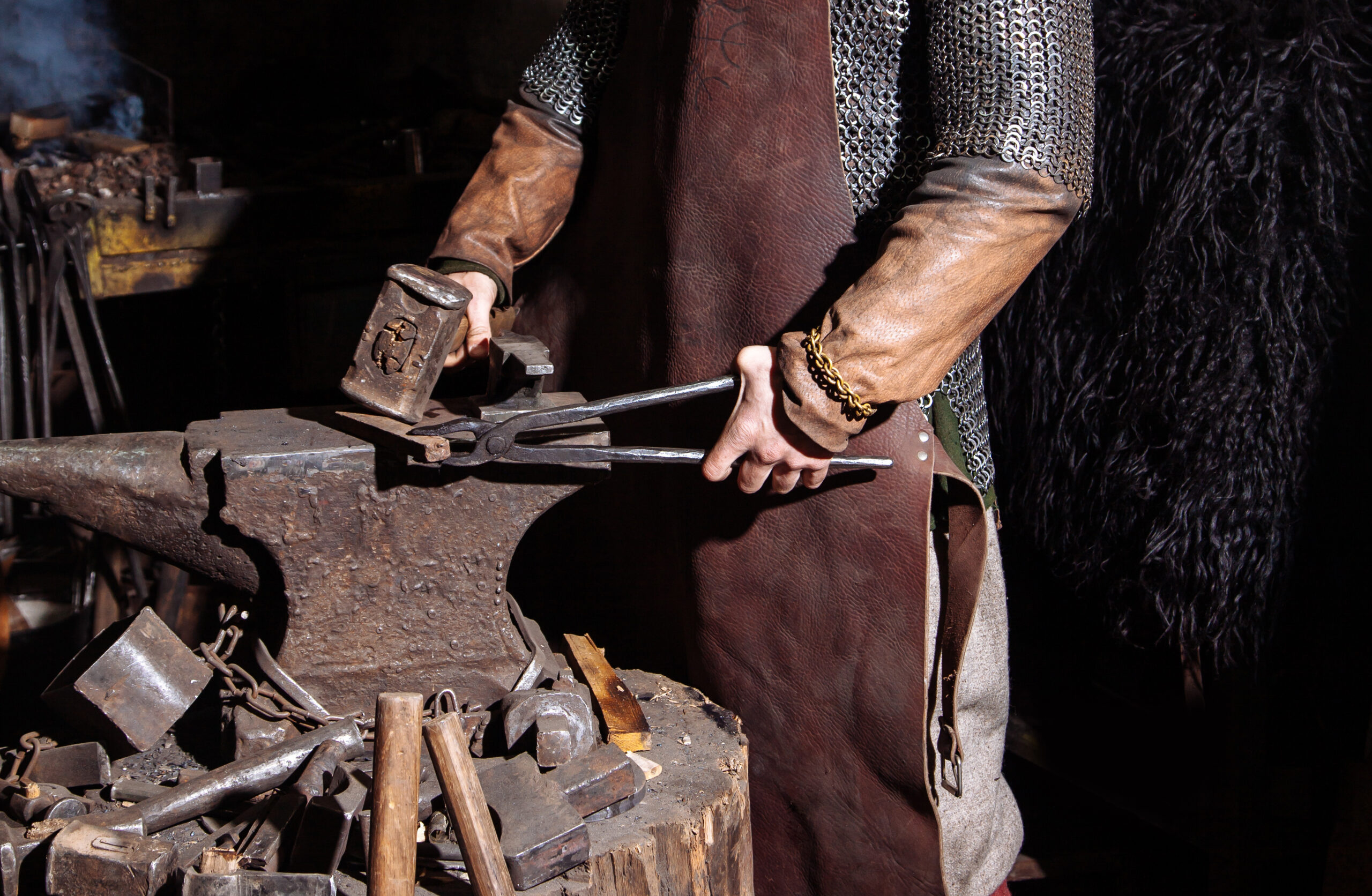
The forge welding was one of the most notable advancements in traditional sword making. The process involved heating individual metal pieces and then hammering them into one blade.
Layering also had several advantages:
- Better flexibility
- Less breakage
- More equal distribution of impurities
Pattern welding, which is usually thought of as merely decorative, was in fact a practical way to address material shortages. The patterns seen are a result of the process rather than a decoration.
Heat Treatment and Hardening
Forging shaped the blade, but heat treatment defined its performance. Hardening and tempering required precise timing and experience.
Smiths heated blades until they reached critical temperature, then quenched them in water or oil. This process hardened the edge but risked cracking. Tempering followed, reheating the blade at lower temperatures to restore flexibility.
Mistakes at this stage could ruin weeks of work. Successful blades reflected careful judgment rather than rigid formulas.
Regional Forging Traditions
The artistry of sword making was not uniform, but rather it was a process that had its own separate evolution in the different civilizations. For instance, Japanese sword making was characterized by the differential hardening of the metal, which was one of the most important techniques employed by the Japanese smiths.
European blades, made with full-length flexibility in mind, were different.
The cutting efficiency was synonymous with the Middle Eastern blades, while such a quality was mostly the case with the swords from that area.
These disparities among the different regions play a significant role in the research and collecting, as they point out the location and time of the swords. Likewise, for the dealers in antique weapons, knowing these characteristics will help them in the process of authentication and appraisal.
Finishing, Grinding, and Assembly
The process of forging was not concluded when the blade was cooled down. Grinding improved its contour and weight distribution. Polishing uncovered the texture and composition. Assembly united blade, guard, handle, and pommel.
All these processes were partly functional. Each one influenced the sword’s behavior as well as its durability. The original tool marks and variations in finishing have become significant indicators of authenticity.
Why Traditional Methods Matter Today
Modern metallurgy can produce stronger steel, but traditional methods created blades that balanced strength, flexibility, and reparability. Studying these techniques helps explain why certain swords survived centuries of use.
Collectors value blades that retain evidence of these methods rather than later alterations. Over-restoration can erase the very details that make a sword historically meaningful.
Understanding Craftsmanship as a Collector
Weapon collectors do not view sword-making skills as a theory but rather as a foundation for the evaluation of the object, the research on its origin, and the preservation of its condition for a long time to come.
Nonetheless, museums, historical records, and recognized dealers are still the sources of trustworthy documentation. A gun shop with a good reputation near my home or a dealer in antique weapons who specializes can frequently assist in differentiating between the firearms and the forged weapons in terms of evaluation.
FAQs
Were all traditional swords handmade?
Yes. Traditional swords were forged by hand, often by a single smith or small workshop.
Is pattern welding the same as modern Damascus steel?
No. Historical pattern welding differs from modern Damascus processes, though they may appear similar.
Do forging marks reduce a sword’s value?
Not necessarily. Original marks often increase historical interest when they reflect authentic craftsmanship.
Should antique swords be polished to look new?
No. Polishing can remove historical evidence and reduce authenticity.
Conclusion
In traditional sword making, the artisanship was so skilled that there was a perfect understanding of materials, heat, and balance, which had been passed down through generations. Having done this, the whole process from raw iron to a finished blade left signs that are still obvious today.
By learning about traditional sword making, the collectors can no longer regard these weapons as purely decorative objects but rather as functional artifacts that have been through time and testing.
The same case applies to those who are concurrently studying forged blades and firearms; the most reliable sources and the most experienced professionals are still the necessities. No matter if the place of employment is a gun store near me or a well-known gun broker, an informed evaluation supports the preservation of the artistry that history has already confirmed.
Collectors Firearms aims to provide you the best guns throughout the world. Contact us today to get more information.