Webley’s WG – The Quintessential Webley
By Bob Carswell
While in St. Louis about a decade ago, I was in Joe Davis’s basement, talking to him about our favorite topic: English revolvers. Of course, if you are talking about English revolvers, you are primarily talking about the Webley. Joe said the WG was the quintessential Webley. This statement, coming from a man who may have approximately one hundred WG pistols and has been an avid collector of these guns for years, was a point to ponder. The next day, on the ‘plane home I started thinking about this statement. It is true; this was Webley’s best finished and largest handgun. To you, Colt collectors, think New Service. As with the New Service, the WG was a favorite of target shooters of the period. At Wimbledon in 1889, the pistol brought from America by Ira Paine was not approved by the British NRA. Under English pistol rules, the rear sight could only be adjusted for windage. Paine’s Smith & Wesson New Model No. 3’s rear sight was also adjustable for elevation. To be able to compete, he borrowed an 1889 WG Army that had no adjustable rear sight. He shot three perfect scores to win the match. Walter Winans and E.E. Patridge were two other great American shooters who also liked the WG. As a matter of fact, these Americans helped Webley with the design of the target models in later years.
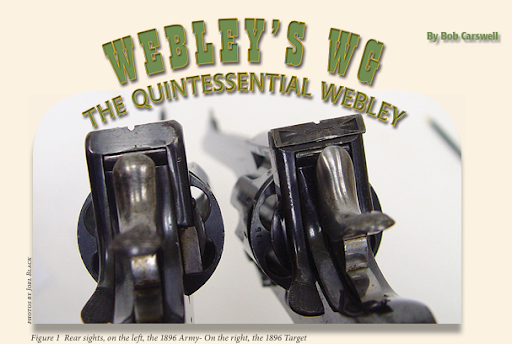
Almost all WG Army pistols have what collectors call bird head grips. These are rounded and are made out of what Webley called Vulcanite, a form of hard rubber. On the other hand, most WG target pistols had wooden square butt grips that were hand checkered. These guns feel very comfortable in the hand. For that reason Webley made some WG Army pistols with square butts for officers who also liked that feel. In this period, officers bought their own handguns. Although the WG was never adopted by the British government, many will be found with officers’ names and regiments, which adds to the fascination for collectors. On a personal note, I do not like the bird head grips when compared to the target grips.
There are several different models of the WG. Webley’s design department was always seeking ways to improve the gun in a period when all manufacturers were doing the same. Today, of course, these design changes also spike the interest of collectors.
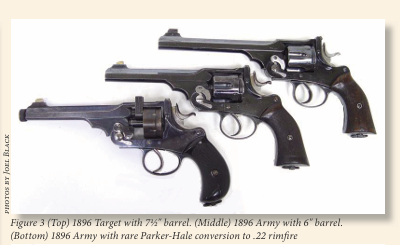
Above, we talked about the Colt New Service. Colt made approx. 360,000 of them, and Webley mad,e but approx. 20,000 WGs. So right off the bat, if you are a collector, you are in a numbers game. The WG is not going to be an easy thing to collect. The guns start at about serial number 1600. T his is where the Kaufmann ends (see previous article in issue #5 of this magazine). There seems to be some question as to what these are called, but let us use Model 1886 as the first model. We then go to the Model 1889, some of which were actually marked “1889 Model”. This is an appropriate point to draw your attention to the “church steeple’s’ flutes on the cylinder. The 1886 also had this feature, but not many people have seen one of these. The 1889 series stops at serial number 3900. We then get the 1891, 1892, 1893, 1894, and so on. All of these are different, and you need to look very closely to see the differences. At about serial 10,300, the last model is introduced. It is the Model 1896, and it is my favorite. Please see pictures of my 1896 Square Butt Army and 1896 7½” Target. In the pictures, you can see the deluxe blue put on the WG. As a matter of fact, this is Webley’s deluxe blue and was on all WGs, except the nickel ones. The WGs were made in three calibers: .450, .455, and .476. The barrel lengths are 6″ and 7 ½” with some 4″ thrown in to make you look really hard. Other lengths are listed in the ledgers and show up once in a blue moon. Also pictured is an 1894 WG with bird’s head grips that was converted to .22 by Parker Hale. It was purchased from a Weller & Dufty auction about 20 years ago. Thanks, Joe Davis; I like this pistol very much. And, of course, you got a pound of flesh from me!
I could not write a column about the WG without explaining what these letters mean. Many think WG stands for Webley Green. They are wrong. As I said above, the British government never bought any WGs, so I can understand how people might think this. However, WG stands for Webley Government. In 1889, Edwinson Charles Green, a well-known gun maker and dealer from Cheltenham, wrote an article in THE FIELD magazine. In that article, he said that he was the inventor of the “stirrup latch,” which was the key to making the WG the most up-to-date, safest handgun of the period. Research shows there was no patent issued under Mr. Green’s name, but Webley had patent no.4070 of 1885 in their name on file. This fact disputes Green’s claim but explains the confusion over the name.
When the WG came out in 1886, it cost 115 shillings (£5.15.0) if blued and 120 shillings (£6.0.0) if nickel plated. I have only brushed the surface of the models above, so if you need or would like to learn more detailed information, please find a copy of Webley Revolvers by Gordon Bruce/Christian Reinhart, which references details of these and other models. By having one of these fine firearms in your hand and studying this book, you will be on your way to understanding the quintessential WG.
Further Reading
Bruce, Gordon and Reinhart, Christian; Webley Revolvers; Verlag Stocker-Schmidt AG, Zurich; 1988 Dowell, William Chipchase; The Webley Story, Commonwealth Heritage Society, Kirkland, Washington; (reprint); 1987